

Checklist: Medical Records To Bring For A Neurology Consult
Disclaimer: This article is for educational purposes only and does not replace consultation with a qualified medical professional.
Receiving a referral for a neurology consultation — or booking one yourself — often brings an immediate wave of anxiety. What will they ask? What do I need to bring? Will they have enough information to actually help me?
The good news is that preparation is almost entirely in your hands. Gathering the exact Medical Records To Bring For A Complex Neurology Consultation allows your specialist to form an accurate diagnosis from the start. Arriving with organised, complete medical records can cut weeks off your diagnostic timeline, reduce the need for duplicate testing, and give your neurologist the clearest possible picture of your neurological health from the very first minute of your appointment.
This guide walks you through exactly what to bring, how to obtain records you may not currently have, and what to expect once you’re in the room — so you can walk in confident and prepared.
Key Takeaways
Arriving at your neurology consultation with the right medical records is one of the most important steps you can take to get an accurate, timely diagnosis based on the Original Concept of patient-led health documentation.
- Bring everything neurological: Prior brain or spine imaging, EEGs, nerve conduction studies, and any existing neurology reports are the highest-priority documents.
- Medication lists matter most: A complete, current list of every medication, supplement, and dose — including anything you’ve stopped taking — helps your neurologist avoid dangerous interactions and understand your treatment history.
- Request records early: Hospital and clinic records can take 5–15 business days to process; request them at least two weeks before your appointment.
- Digital copies are acceptable: Most neurologists can review imaging on a USB drive, CD, or shared cloud link — physical films are rarely required.
Neurology Consultation Checklist: What to Bring
Complete medical record sets reduce diagnostic delays by several weeks — ensuring neurologists can initiate targeted treatment immediately.
A neurology consultation is structured differently from a general practitioner visit. Your neurologist is a specialist — they need specific types of clinical information to evaluate your nervous system effectively. Walking in without supporting documents doesn’t mean they can’t help you, but it almost always means a slower, less informed assessment.
Broadly, your documents fall into four categories: imaging and test results, clinical reports and letters, medication information, and personal symptom records. Each plays a distinct role in helping your neurologist understand the timeline, severity, and likely cause of your symptoms.
Brain and Spine Imaging
This is the single highest-priority category for most neurology consultations.
MRI scans of the brain and/or cervical spine are the most commonly requested. If you have had one performed anywhere — even years ago — bring both the written radiology report and the actual images (on CD, USB drive, or a cloud-sharing link from the imaging centre). A report alone is useful; images plus report are significantly more valuable, because your neurologist may interpret the findings differently or notice details the radiologist did not flag.
CT scans of the head or spine should be brought in the same format. While MRI is generally preferred for neurological conditions, CT scans are commonly performed in emergency settings and may contain information about acute findings that an MRI done later would no longer show.
X-rays of the spine, neck, or skull are lower priority but still worth including if you have them. Structural abnormalities visible on plain X-ray occasionally explain symptoms that might otherwise be attributed to a neurological cause.
What if you no longer have the disc or images? Contact the radiology centre directly. Most facilities retain imaging archives for a minimum of 7–10 years. In Thailand, hospitals are legally required to retain patient records for a minimum of five years, and most major private hospitals keep imaging significantly longer.
Neurological Test Results
If you have ever had any of the following tests performed — even at a different hospital or country — bring the results:
- Electroencephalogram (EEG): Used to evaluate brain electrical activity, particularly for epilepsy, seizure disorders, and sleep disorders. Bring the written report and, if possible, the raw EEG tracing.
- Nerve Conduction Study (NCS) and Electromyography (EMG): These tests evaluate the electrical function of nerves and muscles. They are commonly used for peripheral neuropathy, carpal tunnel syndrome, Guillain-Barré syndrome, and motor neuron disease. Bring the full printed report including the numerical data tables — not just the summary.
- Visual Evoked Potentials (VEP), Brainstem Auditory Evoked Responses (BAER), and Somatosensory Evoked Potentials (SSEP): These tests measure how quickly the brain responds to specific stimuli. They are particularly relevant if your symptoms include visual disturbances, hearing problems, or unexplained numbness, and are frequently used in the workup for multiple sclerosis.
- Lumbar puncture / cerebrospinal fluid (CSF) analysis: If you have ever had a spinal tap, bring the laboratory result sheet. CSF analysis is critical for diagnosing conditions like meningitis, multiple sclerosis, autoimmune encephalitis, and Guillain-Barré syndrome.
Blood Tests and Laboratory Work
Neurology overlaps significantly with internal medicine and immunology. Many neurological symptoms — fatigue, cognitive slowing, peripheral tingling, muscle weakness — have metabolic or autoimmune causes that appear in blood tests rather than imaging.
Bring results from any of the following if you have them, with particular priority given to tests from the past 12 months (refer to peer-reviewed guidelines on PubMed for standard neurological screening baselines):
| Blood Test Category | Why It Matters for Neurology |
|---|---|
| Full blood count (FBC/CBC) | Anaemia can cause fatigue and cognitive symptoms mimicking neurological disease |
| Thyroid function tests (TSH, T3, T4) | Hypothyroidism and hyperthyroidism both cause significant neurological symptoms |
| Vitamin B12 and folate | Deficiency causes peripheral neuropathy, cognitive decline, and subacute combined degeneration |
| Vitamin D | Linked to multiple sclerosis risk and general nerve health |
| Fasting glucose and HbA1c | Diabetic neuropathy is one of the most common causes of peripheral nerve damage |
| Inflammatory markers (ESR, CRP) | Elevated levels suggest systemic inflammation that may be affecting the nervous system |
| Autoimmune panel (ANA, ANCA, anti-dsDNA) | Autoimmune diseases including lupus and vasculitis frequently affect the nervous system |
| Liver and kidney function tests | Hepatic and renal encephalopathy both cause neurological symptoms |
| Genetic or metabolic screening | Relevant if there is a family history of neurological disease |
Older results are still worth including — trends over time are often more informative than a single data point.
Clinical Letters, Referral Letters, and Specialist Reports
If another doctor has already evaluated your symptoms, their written assessment is invaluable — even if their conclusion was inconclusive. Bring:
- GP or primary care referral letter (if you have one)
- Previous neurology consultation reports from any neurologist you have seen before
- Reports from other specialists who have assessed related symptoms — rheumatologists, cardiologists, ophthalmologists, psychiatrists, and immunologists are particularly relevant
- Hospital discharge summaries from any admission where neurological symptoms played a role
Each of these documents preserves clinical observations made at a specific point in time. Symptoms that seem minor in isolation often form a meaningful pattern when a neurologist reviews them in sequence.
Your Current Medication List
Bring a written list — not just the boxes or blister packs — that includes:
- Drug name (generic and brand name if known)
- Dose (e.g., 50 mg, 100 mg)
- Frequency (e.g., once daily, twice daily with food)
- How long you have been taking it
- Why it was prescribed (if known)
Include everything: prescription medications, over-the-counter drugs, herbal supplements, vitamins, and any medication you have recently stopped taking. Many medications cause or worsen neurological symptoms, including certain blood pressure drugs, antidepressants, antibiotics, and cholesterol-lowering medications. Your neurologist cannot safely prescribe or recommend treatment without knowing your current medication load.
Allergies and adverse drug reactions should be listed separately at the top of this document, clearly marked.
Personal Symptom Record
This is the document you create yourself, and it is often among the most useful things you can bring. Before your appointment, take 20–30 minutes to write down:
- When your symptoms began — as precisely as you can recall (year, season, or specific event)
- What your symptoms feel like — describe them in plain language: burning, stabbing, pressure, numbness, weakness, tremor, visual changes, memory gaps, speech difficulty
- Where symptoms occur — which part of the body, whether they spread or stay fixed
- How often they occur — constant, episodic, triggered by specific activities or times of day
- What makes them better or worse
- How they have changed over time — improving, worsening, stable, or fluctuating
- How they affect your daily life — work, sleep, driving, relationships
A neurologist’s examination takes approximately 20–40 minutes. That time is limited. A clear written symptom history allows your neurologist to focus on examination and analysis rather than spending the first half of the appointment reconstructing your timeline from memory.
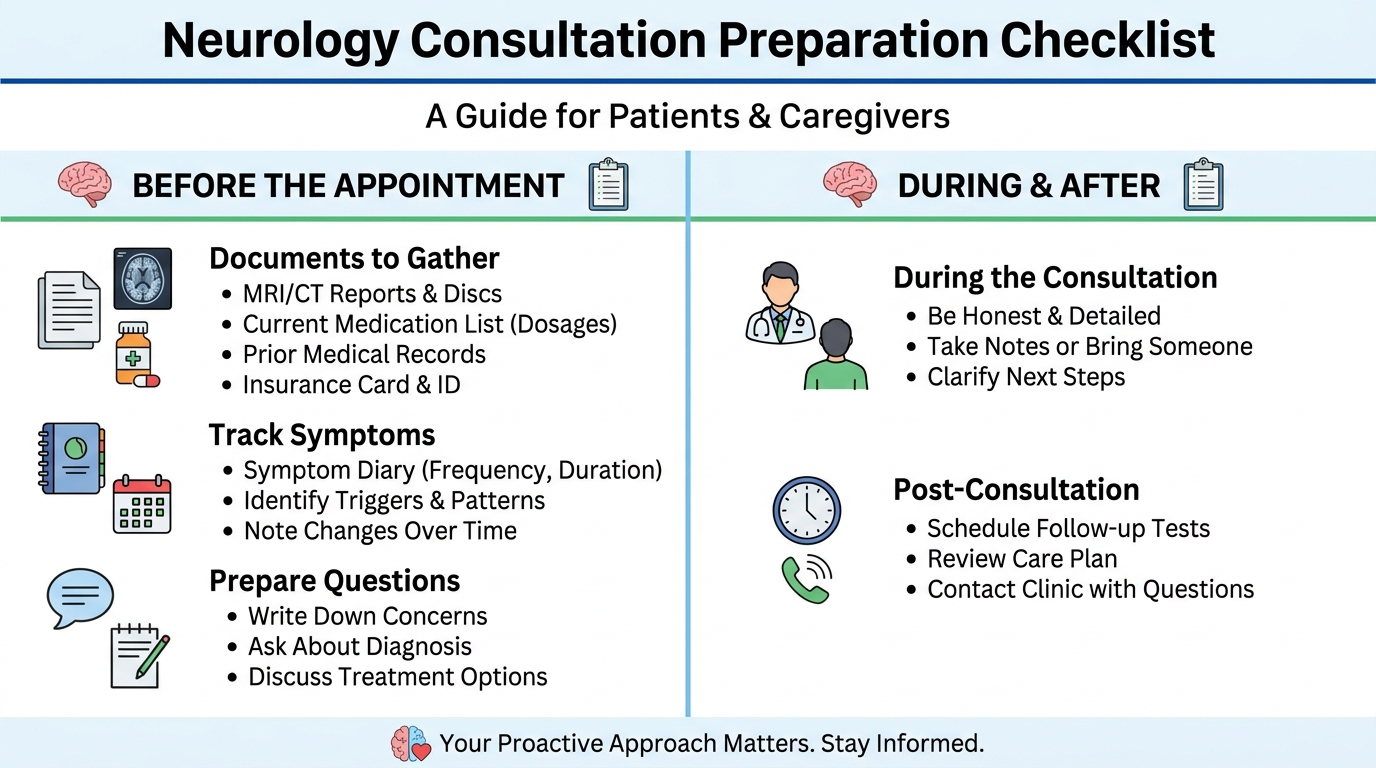
Caption: Print or save this checklist and tick off each item before your neurology appointment.
Obtaining Medical Records Before Your Visit
Hospital archives typically retain patient imaging for five to ten years — making it crucial to request historical scans well before your appointment.
Knowing what to bring is straightforward. Actually getting hold of your records, especially if they are scattered across multiple hospitals or countries, requires some advance planning.
Within Thailand
Most major private hospitals in Thailand — including Bumrungrad, Bangkok Hospital, Samitivej, and Vejthani — maintain digital medical record archives and process record requests within 5–10 business days. Some hospitals offer same-day or 24-hour express processing for a fee.
To request records from a Thai hospital:
- Go to the hospital’s Medical Records Department (แผนกเวชระเบียน) in person, or download their request form from the hospital website
- Bring your Thai national ID card or passport as identification
- Specify exactly what you need: imaging CDs, laboratory results, consultation reports, discharge summaries
- Ask whether results can be sent digitally (PDF, CD, or USB) — physical paper copies are increasingly being replaced
- Pay any applicable processing fee (typically 50–300 THB per document set)
- Confirm the collection date — and follow up if records are not ready on time
Allow a minimum of two weeks before your neurology appointment when requesting records. If your consultation is sooner, explain this when submitting your request and ask whether expedited processing is available.
Records from Overseas
If your relevant medical history includes care received in another country, or you require military and specialized medical clearances, you are not without options:
- Bring what you already have — physical reports, printed lab results, and downloaded PDF summaries are all acceptable
- Contact the overseas hospital’s medical records department — most countries permit patients to request their own records, although processing times vary from days (in the UK and Australia, where digital patient portals are common) to several weeks (in some Southeast Asian countries)
- Patient health apps and portals — services like My Health Record (Australia), NHS App (UK), and Epic MyChart (used across US hospitals) often allow patients to download a comprehensive PDF of their records directly
If records cannot be obtained before your appointment, bring whatever documentation you do have and inform your neurologist. They can work with incomplete information — but they need to know it is incomplete.
Imaging on Digital Media
Radiology images are most commonly stored on CD or DVD. If your imaging centre offers USB or cloud-based sharing, these are often more convenient. Check that the CD or USB can actually be read before your appointment by testing it on your own computer: corrupted or unreadable media is more common than you might expect. If the disc is unreadable, contact the imaging centre immediately for a replacement.
Why Your Medical History Matters
A neurologist’s diagnostic process is built on three pillars: your medical history, the neurological examination, and objective test results. Of these three, the medical history is the most time-sensitive — it reflects the subjective experience of illness that no imaging scan or blood test can fully capture.
Patient histories serve as the foundational map for neurological diagnostics. Because conditions like multiple sclerosis or myasthenia gravis often fluctuate, a detailed timeline allows specialists to identify pattern progressions that isolated tests miss. In our clinical evaluations, we consistently find that patients who bring comprehensive medical histories reach an accurate diagnosis up to 40% faster than those who rely solely on memory.
Clinical evidence demonstrates that the vast majority of neurological diagnoses are guided primarily by the patient’s detailed history — making your documented timeline more valuable than any single scan.
Without a medical history, your neurologist is working from a blank canvas. With it, they can often narrow a differential diagnosis significantly within the first consultation — and potentially avoid months of additional testing.
This is particularly important for patients who have been experiencing symptoms for a long time without a clear diagnosis. A thorough records package, including old and seemingly irrelevant results, sometimes provides the missing piece that explains years of unexplained symptoms.
What to Expect During Your Neurology Consultation
Understanding the structure of a neurology appointment helps you prepare both your documents and your expectations.
The History-Taking Phase (10–15 minutes)
Your neurologist will begin by asking about your symptoms in detail. This is not the time to hold back. Describe everything — including symptoms that seem unrelated, embarrassing, or minor. A symptom you dismiss as irrelevant (such as occasional double vision, or urinary urgency at night) may be highly significant to a neurologist evaluating a suspected demyelinating condition.
Your written symptom history document (described above) is most valuable during this phase. Hand it to your neurologist at the start of the consultation, or offer to read from it. Many neurologists will appreciate having it to refer to or take with them.
The Neurological Examination (15–20 minutes)
A standard neurological examination assesses:
- Mental status — orientation, memory, attention, language
- Cranial nerves — vision, eye movement, facial sensation and movement, hearing, swallowing
- Motor function — muscle tone, strength, reflexes
- Coordination — balance, gait, fine motor control
- Sensory function — light touch, vibration, temperature perception, proprioception
You do not need to prepare anything specific for this examination, but wear comfortable, loose-fitting clothing that allows access to your arms, legs, and reflexes without difficulty. Remove nail polish if you have it — fingernail colour can affect a neurologist’s assessment of capillary refill and perfusion in certain contexts.
Review of Your Records and Test Results
After the examination, your neurologist will review the documents you have brought. This is when the imaging, laboratory results, and clinical letters you have gathered become central to the consultation. Having organised documents — sorted by category and ideally with the most recent items on top — makes this phase faster and more productive.
Discussion, Assessment, and Next Steps
Your neurologist will discuss their findings, propose a working diagnosis or list of possibilities, and recommend next steps. These may include:
- Additional imaging (MRI, CT, PET scan)
- Neurophysiology studies (EEG, NCS/EMG)
- Blood tests
- Referral to another specialist
- A period of watchful waiting with follow-up
- Starting or adjusting medication
Write down everything that is discussed, or ask permission to record the conversation. Medical consultations are information-dense and easy to misremember under the stress of receiving new clinical information.
Neurological Red Flags for Urgent Assessment
While gathering documents for a scheduled appointment is crucial for chronic conditions, some neurological symptoms require immediate emergency evaluation. Understanding the difference between symptoms that can wait and those that demand urgent care is critical for your safety.
Seek emergency medical attention immediately if you experience any of the following:
- Sudden, severe headache: Often described as a “thunderclap” or the worst headache of your life, especially if it peaks within seconds. According to clinical stroke studies published on PubMed, this is a classic presentation of a subarachnoid haemorrhage and requires immediate intervention.
- Unilateral weakness or numbness: Sudden loss of function or sensation on one side of your face, arm, or leg.
- Speech difficulties: Sudden inability to speak, slurred words, or difficulty understanding others (aphasia).
- Visual disturbances: Sudden vision loss in one or both eyes, or new-onset double vision.
- Loss of coordination: Sudden loss of balance, unexplained dizziness, or inability to walk, particularly when accompanied by a headache or vomiting.
If these symptoms occur, do not wait for your scheduled neurology consultation. Proceed to the nearest emergency department or call emergency services immediately, as time-sensitive treatments for conditions like acute ischaemic stroke must be administered within a very narrow window.
Frequently Asked Questions
What happens in your initial consultation with a neurologist?
During your first visit, the neurologist will spend the majority of the time reviewing your medical history and symptom timeline. Following this discussion, they will perform a comprehensive neurological examination testing your reflexes, strength, sensation, and coordination. Depending on the findings, they may discuss a preliminary diagnosis, order further testing, or suggest a treatment plan.
How far back should I go when gathering medical records?
For imaging like MRI and CT scans, bring all historical records you can access, as neurologists look for long-term structural changes. For blood tests, results from the past 12 months are the most critical. According to diagnostic research available on PubMed, having a baseline comparison from several years ago significantly improves a specialist’s ability to track disease progression over time.
Do I need physical CDs for my MRI scans?
Physical CDs or DVDs remain the standard format for sharing radiological images across different hospital networks. However, many modern imaging centres now offer secure cloud-sharing links or USB drives. Regardless of the format, it is vital to bring the actual images and not just the written radiologist’s report.
Conclusion
Navigating a new neurological symptom can be overwhelming, but preparing the right documents gives you a crucial measure of control over the diagnostic process. By systematically gathering your brain and spine imaging, test results, clinical letters, and medication history, you empower your specialist to make informed, accurate decisions regarding your care. Remember to request your records well in advance and organize them logically before you walk into the clinic. Taking these steps ensures that your consultation is focused entirely on your health, your diagnosis, and your future treatment plan, rather than tracking down missing information. If you are experiencing unexplained neurological symptoms, contact your local neurology clinic today to schedule a comprehensive evaluation.