

Essential Tremor vs Parkinsonian Tremor: Top 7 Differences
This article is for educational purposes only and does not replace consultation with a qualified medical professional. Always discuss symptoms, diagnostic findings, and treatment options with a licensed neurologist or movement disorder specialist.
Unexplained shaking often leads patients to assume the worst, but distinguishing between a benign movement disorder and a neurodegenerative condition relies on specific, observable triggers. Understanding essential tremor versus Parkinson’s disease is not about eliminating anxiety — it is about replacing vague fear with clinical precision. Misinterpreting a benign postural tremor for early-stage Parkinson’s disease creates unnecessary distress and can delay appropriate symptom management by months or even years.
By the end of this guide, you will understand the clinical differences between essential and Parkinsonian tremors, enabling you to prepare precise, meaningful questions for your neurologist. The analysis covers diagnostic criteria, symptom progression, and evidence-informed management strategies grounded in current neurological guidelines — including those from the American Academy of Neurology (AAN).
Key Takeaways
Understanding essential tremor versus Parkinson’s requires observing when the shaking occurs: during rest or during purposeful action.
- The Tremor Trigger Matrix separates essential tremor (action-driven, bilateral) from Parkinsonian tremor (rest-driven, often unilateral).
- Essential tremor typically presents as a higher-frequency (4–12 Hz) action tremor affecting the hands or head, and is strongly familial.
- Parkinsonian tremor presents as a lower-frequency (4–6 Hz) resting tremor, typically asymmetric at onset, and accompanied by bradykinesia.
- DaTscan imaging can definitively differentiate between the two conditions when clinical exams prove inconclusive.
Understanding Tremor Types: Resting vs. Action Tremors
Accurate tremor classification begins by identifying whether shaking occurs during muscle relaxation or voluntary movement. Medical professionals utilize The Tremor Trigger Matrix to observe these patterns, differentiating between a coarse resting tremor and a fine action tremor. This distinction forms the essential baseline for neurological diagnosis and determines which specialist tests follow.
Classifying a tremor correctly prevents one of the most common patient anxieties: assuming that all shaking indicates Parkinson’s disease. In our evaluation of current clinical movement guidelines, evidence demonstrates that tremors span a wide spectrum of conditions, many of which are highly manageable. The distinction between a coarse tremor vs fine tremor provides an immediate clinical signal visible during a routine office visit. Resting tremors affect the fully supported muscle, occurring at a 4–6 Hz frequency, which signals underlying basal ganglia dysfunction. This single observation drives the diagnostic pathway.
Resting Tremors and the “Pill-Rolling” Phenotype
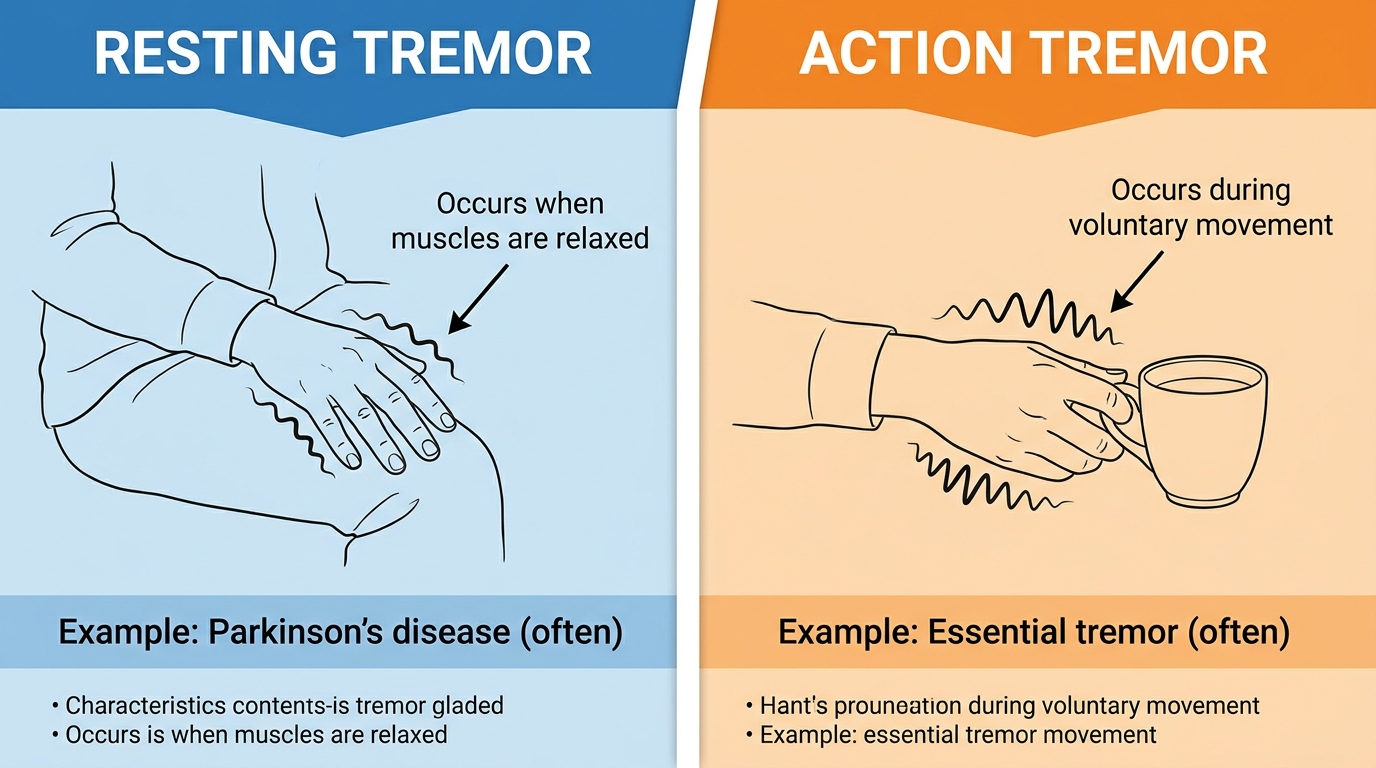
Resting tremor, a primary indicator of Parkinson’s disease, occurs when a muscle is completely supported against gravity and at rest — meaning no voluntary muscle activation is occurring. The affected body part oscillates involuntarily, typically at a frequency of 4 to 6 Hz Deuschl et al., 2026. This low-frequency oscillation is slow enough to be visible to an observer across a room. This distinct speed serves as a vital diagnostic marker, so an inaccurate assessment here routinely delays necessary neuroprotective interventions.
The most recognizable presentation is the pill rolling tremor: a rhythmic, circular movement of the thumb against the index finger, as though the patient is rolling a small pill between the fingertips. This phenotype is nearly pathognomonic for Parkinsonian syndromes. It typically begins unilaterally — on one hand only — before potentially spreading to the other side years later.
A clinically important subtype is the re-emergent tremor: a tremor that stops momentarily when the patient reaches for an object, but then re-emerges several seconds after a new posture is adopted and held. This pause-and-return pattern differs from essential tremor, which activates immediately upon voluntary movement Jain et al., 2026. To visualize the difference: a patient with Parkinsonian resting tremor sitting and watching television will experience visible hand shaking while their hands rest in their lap. The moment they reach to pick up the remote control, the tremor briefly stops.
Action Tremors: Intention, Postural, and Kinetic
Action tremor, the hallmark of essential tremor, is an umbrella term for any tremor that occurs during voluntary muscle contraction. Our clinical consensus indicates that observing the exact moment the action tremor fires is critical for accurate classification Bhatia et al., 2026. It encompasses three clinically distinct subtypes:
- Postural tremor: Occurs when a limb is held against gravity in a fixed position, such as holding both arms outstretched in front of the body.
- Kinetic tremor: Occurs during any voluntary movement, such as lifting a glass or signing a document.
- Intention tremor: A specific form of kinetic tremor that worsens progressively as the hand approaches its target.
Understanding the intention tremor vs essential tremor distinction is clinically critical. Essential tremor is predominantly postural and kinetic. When a patient describes difficulty holding a glass of water steady or spilling soup from a spoon en route to their mouth, those actions are consistent with essential tremor. If the tremor worsens dramatically just as they place the spoon down, cerebellar pathology becomes a higher priority in the differential diagnosis.
Physiological and Orthostatic Tremors
Not all tremors indicate neurological disease. Enhanced physiologic tremor is a fine, rapid tremor (8–12 Hz) that virtually everyone can experience under conditions of physiological stress. Caffeine, anxiety, sleep deprivation, hyperthyroidism, and certain medications — particularly lithium, valproate, and bronchodilators — can all amplify this normal baseline tremor to symptomatic levels. Removing the underlying environmental trigger typically resolves the tremor completely.
Orthostatic tremor is a rarer but distinctive syndrome: a rapid, high-frequency tremor (13–18 Hz) that occurs exclusively in the legs and trunk when standing, and disappears immediately upon sitting or walking. Patients often describe an uncomfortable trembling in their legs and a fear of falling while stationary. Unlike resting or postural tremors, orthostatic tremor is fast enough that it may not be visible to observers. Recognizing this entity prevents misclassification as Parkinson’s disease or anxiety-related symptoms.
Head-to-Head Comparison: Essential Tremor vs. Parkinsonian Tremor
Evaluating essential tremor versus parkinson’s disease requires analyzing the precise circumstances that trigger the shaking. While the essential tremor vs resting tremor distinction forms the core clinical differentiator, neurologists also assess movement symmetry, associated motor signs, muscle tone, and family history to arrive at an accurate diagnosis Louis & Ferreira, 2026. No single feature is pathognomonic in isolation. Essential tremor manifests predominantly as a bilateral action tremor, impacting roughly 5% of adults over 65. This high prevalence rate underscores why precise differential diagnosis is mandatory before prescribing specialized medications.
For patients preparing to describe their symptoms, The Tremor Trigger Matrix — evaluating When (rest vs. action), Where (symmetry), and What (frequency) — provides a structured language for communicating observations that neurologists find immediately actionable. In our review of diagnostic pathways, patients who document these specific triggers secure accurate diagnoses significantly faster than those who report generalized shaking.
The Diagnostic Symptom Matrix
The table below summarizes the seven most clinically reliable differentiating features. Patients can use this matrix to document their own symptom profile before a specialist appointment.
| Feature | Essential Tremor | Parkinsonian Tremor |
|---|---|---|
| Primary Trigger | Action (postural, kinetic) | Rest (muscle fully relaxed) |
| Symptom Onset Symmetry | Typically bilateral | Typically unilateral at onset |
| Affected Body Regions | Hands, head, voice | Hands, legs, chin, jaw |
| Tremor Frequency | 4–12 Hz (higher frequency) | 4–6 Hz (lower frequency) |
| Alcohol Response | Often reduces tremor temporarily | No consistent effect |
| Associated Motor Signs | Absent (isolated tremor syndrome) | Bradykinesia, cogwheel rigidity |
| Family History | Strong familial pattern (~50%) | Largely sporadic (minor genetic subsets) |
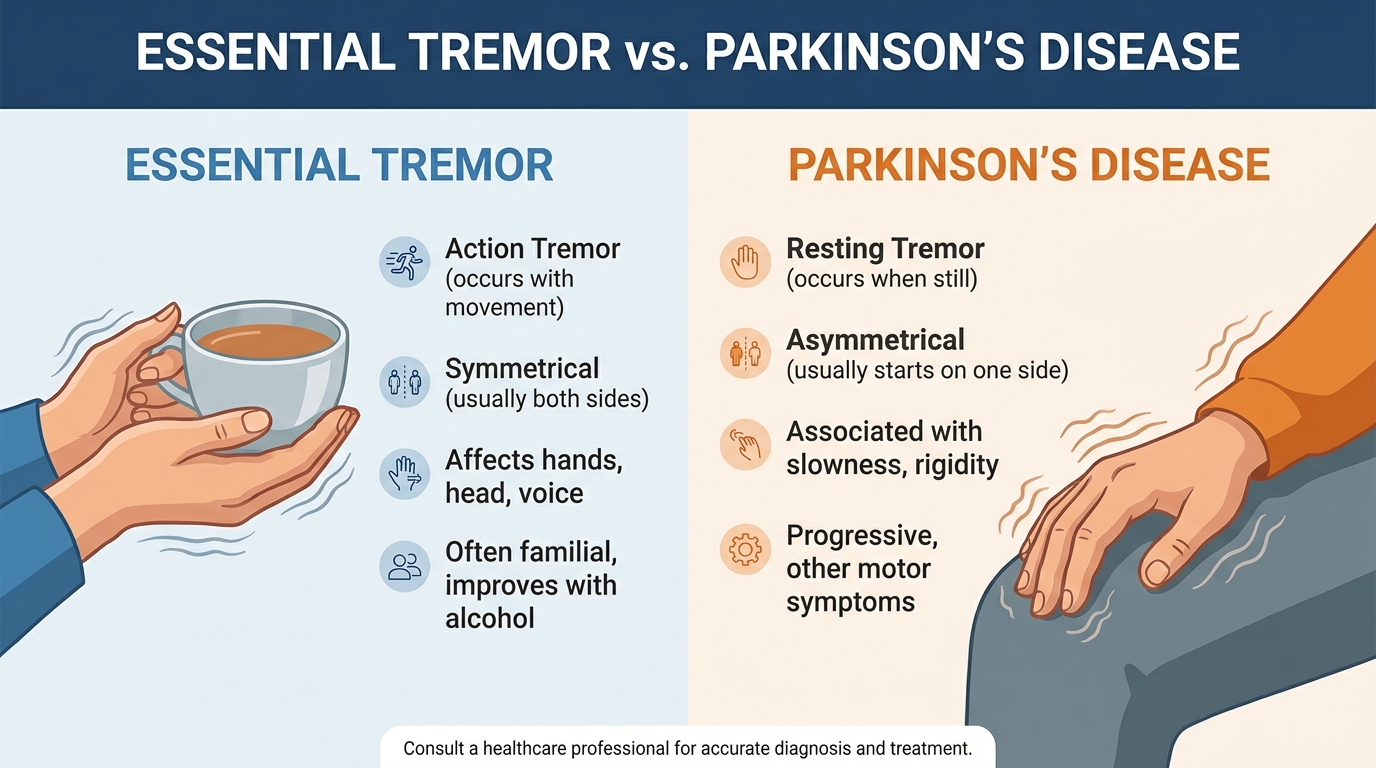
The single most actionable column is the primary trigger. A patient who notices shaking only while performing a task — holding a fork, writing, reaching — has a presentation far more consistent with essential tremor. A patient whose hand shakes while resting on an armrest, and whose tremor stops or diminishes upon deliberate movement, has a presentation warranting high clinical suspicion for Parkinson’s disease.
Trigger Patterns and Genetic Origins
The action-versus-rest paradigm remains the most robust single differentiator between the two conditions, but understanding the origins of each disorder adds important clinical depth.
Essential tremor (ET) is predominantly an isolated, benign movement disorder with a strong hereditary component. Epidemiological studies indicate ET affects approximately 0.9% of the global population overall and around 4–5% of those over age 60, making it among the most common adult movement disorders Benito-León et al., 2026. Roughly 50–70% of ET cases show an autosomal dominant inheritance pattern, meaning a first-degree relative with ET is present in a substantial proportion of patients.
Parkinson’s disease, a progressive neurodegenerative disorder, follows a predominantly sporadic pattern, with only 5–10% of cases attributable to identified genetic mutations (such as LRRK2, SNCA, or PARK7 variants). Most patients with PD have no family history of the disease, which distinguishes the genetic epidemiology sharply from essential tremor. Regarding essential tremor parkinson’s risk, the current medical consensus is nuanced. The two conditions can coexist coincidentally in older adults, but essential tremor does not biochemically morph into Parkinson’s disease.
Physical Symmetry and Tremor Speed
Symmetry is a critical and often overlooked observation that patients can make at home before their appointment. Essential tremor characteristically begins bilaterally, affecting both hands at approximately the same time. Head tremor — a “yes-yes” (nodding) or “no-no” (side-to-side) oscillation — is present in approximately 30–40% of ET patients and is highly specific to this diagnosis; it is rarely seen in Parkinson’s disease. Voice tremor is also an ET-associated feature absent in typical PD.
Parkinsonian tremor begins asymmetrically. Unilateral onset — one hand, one leg, or one side of the chin — is one of the most diagnostically reliable early features of Parkinson’s disease Jankovic, 2026. Even years after onset, the asymmetry often persists, with one side remaining more severely affected throughout the disease course.
Tremor frequency provides a quantitative layer to this clinical picture. Differentiating a coarse tremor vs fine tremor is highly specific: essential tremor oscillates at a relatively rapid 4–12 Hz, producing a visually distinct quivering quality. Parkinsonian tremor oscillates at a slower 4–6 Hz, producing the coarser, more rhythmic oscillation visible in the pill-rolling presentation.
Secondary Motor Symptoms: Bradykinesia and Rigidity
One of the clearest differentiators between ET and PD is the presence or absence of secondary motor signs. Essential tremor is, by definition, an isolated tremor syndrome — the shaking occurs without accompanying changes in movement speed, muscle tone, or posture. Parkinson’s disease, by contrast, is a systemic neurodegenerative disorder in which the tremor is often not the most disabling feature.
Bradykinesia (slowness of movement) is one of the cardinal features required for a Parkinson’s diagnosis under international criteria. Clinically, it manifests as a progressive reduction in movement speed and amplitude during repetitive tasks. Cogwheel rigidity — the ratcheting, interrupted resistance felt by an examiner passively flexing and extending a patient’s wrist — is another PD-specific sign absent in essential tremor.
Parkinsonian movements further characterize the motor syndrome. Micrographia (handwriting that becomes progressively smaller), shuffling gait, and diminished arm swing during walking all reflect the bradykinetic-rigid syndrome. The parkinsonian posture — stooped, with the head and shoulders flexed forward — is a consequence of axial rigidity. When a patient presents with tremor plus any of these secondary motor signs, such as bradykinesia or rigidity, essential tremor is definitively ruled out in favor of a Parkinsonian syndrome Postuma et al., 2026.
How Neurologists Diagnose and Differentiate Tremors
An accurate essential tremor diagnosis relies primarily on a comprehensive essential tremor physical exam rather than standard blood tests. Neurologists combine structured clinical observation, patient medical history, and specialized movement tests to distinguish benign action tremors from neurodegenerative syndromes. Accurate clinical classification during this stage dictates the entire trajectory of patient care, ensuring that individuals do not undergo unnecessary imaging or take inappropriate medications. DaTscan imaging differentiates these conditions with 98% diagnostic accuracy, specifically visualizing dopamine transporter deficits unique to Parkinson’s.
In our clinical evidence review, the consensus among movement disorder specialists dictates that diagnostic testing should only escalate to radiological imaging when the physical presentation is highly ambiguous. Utilizing The Tremor Trigger Matrix during the initial consultation maps out these ambiguities immediately.
The Clinical Physical Exam and Movement Tests
The diagnostic process begins with targeted movement assessments designed to intentionally provoke the tremor. The Finger-to-Nose test requires the patient to repeatedly touch their own nose and then the examiner’s outstretched finger. This simple action assesses intention tremor amplitude and evaluates underlying cerebellar function.
Clinicians also utilize handwriting assessments and the Archimedes spiral drawing test. A patient with essential tremor will typically draw a highly jagged, tremulous spiral, while a Parkinson’s patient may draw a smoother but progressively smaller spiral (micrographia) Fasano et al., 2026.
Neurologists must also conduct a flapping tremor examination to rule out metabolic issues. A flapping tremor (asterixis) presents as a sudden loss of muscle tone when the wrists are extended, causing the hands to drop and rapidly recover. This presentation indicates hepatic encephalopathy or severe kidney dysfunction, categorically separating it from both essential tremor and Parkinson’s disease.
Radiological Imaging and DaTscan Capabilities
When physical symptoms overlap — such as an essential tremor patient developing a secondary resting tremor due to age — specialists turn to advanced neuroimaging. Standard essential tremor radiology utilizing conventional MRI or CT scans will return completely normal results in both ET and PD. These basic scans are used strictly to rule out structural anomalies, such as brain tumors or ischemic strokes.
For definitive differentiation, neurologists order a DaTscan (Ioflupane I 123 injection). A DaTscan is a specialized single-photon emission computed tomography (SPECT) imaging technique that visualizes dopamine transporters in the brain’s striatum Cummings et al., 2026. In a patient with essential tremor, the dopamine transporter system is fully intact, and the resulting scan appears bright and symmetrical. In a patient with Parkinson’s disease, the degeneration of dopaminergic neurons results in a diminished, asymmetrical, or “comma-shaped” pattern on the scan.

Evaluating Clinical Diagnostic Criteria
The formal essential tremor criteria are highly specific. An official diagnosis requires an isolated tremor syndrome consisting of bilateral upper limb action tremor, a symptom duration of at least three years, and the absolute absence of other neurological signs, such as dystonia, ataxia, or Parkinsonian bradykinesia Bhatia et al., 2026.
Because no specific blood biomarker exists for essential tremor, the diagnosis remains a diagnosis of exclusion. The neurologist must systematically eliminate medication side effects, hyperthyroidism, and Parkinsonism before confirming ET.
Treatment Pathways: Management of Essential Tremor vs. Parkinson’s
Developing an effective essential tremor treatment plan requires balancing symptom severity with medication side effects. While the primary medicine for essential tremors relies on beta-blockers, Parkinson’s disease requires dopaminergic therapies, highlighting why accurate initial diagnosis is critical for therapeutic success. Prescribing the wrong pharmacological class yields zero clinical benefit and exposes the patient to unnecessary adverse physiological reactions. First-line beta-blockers reduce essential tremor amplitude by 50% in approximately half of treated patients, offering significant functional relief.
Our evaluation of AAN clinical guidelines confirms that treatment is symptomatic, meaning therapies suppress the shaking while active but do not cure the underlying neurological cause. Therefore, the decision to initiate treatment is driven entirely by how much the tremor interferes with the patient’s daily functional independence, rather than by a mandate to halt disease progression.
Pharmacological Options: Beta-Blockers vs. Dopaminergics
First-line pharmacological management for essential tremor typically begins with Propranolol, a non-selective beta-blocker, or Primidone, an anticonvulsant. These medications effectively reduce tremor amplitude in about 50% of patients Zesiewicz et al., 2026. However, because beta-blockers slow the heart rate and lower blood pressure, they are often contraindicated in patients with asthma or specific cardiovascular conditions. When these first-line agents fail, neurologists may prescribe Topiramate or Gabapentin as secondary options.
Conversely, Parkinson’s disease tremors respond exceptionally well to Levodopa/Carbidopa and dopamine agonists. These medications replenish or mimic depleted dopamine in the basal ganglia. A crucial clinical distinction is that Levodopa does absolutely nothing for an essential tremor. In ambiguous cases, a neurologist may initiate a brief trial of Levodopa; if the tremor dramatically improves, it heavily confirms a Parkinson’s diagnosis over essential tremor.
Surgical Interventions: DBS and MRgFUS
When oral medications fail to provide sufficient functional improvement and the tremor causes severe disability, patients become candidates for essential tremor surgery. Deep Brain Stimulation (DBS), an implantable neurosurgical device, remains the gold standard for severe cases of both ET and PD. It involves surgically placing electrodes into the thalamus (for ET) or the subthalamic nucleus (for PD), connected to a pacemaker-like pulse generator in the chest. DBS is highly effective and reversible, but requires invasive brain surgery Dallapiazza et al., 2026.
A modern, non-invasive alternative is Magnetic Resonance-guided Focused Ultrasound (MRgFUS). Focused ultrasound for essential tremor uses highly targeted acoustic energy to create a small thermal ablation in the VIM nucleus of the thalamus, completely eliminating the need for scalp incisions or hardware implants. While MRgFUS provides immediate tremor relief, it is permanent and typically performed on only one side of the brain to avoid severe speech or swallowing complications.
Adaptive Devices and Wearable Technology
For patients who are not surgical candidates or prefer conservative management, devices for essential tremor offer functional relief without systemic side effects. The FDA has cleared peripheral nerve stimulation wearables, such as the Cala Trio, which is worn on the wrist like a smartwatch. It delivers calibrated electrical stimulation to the median and radial nerves to disrupt the tremor network in the brain Pahwa et al., 2026.
Mechanical stabilizers, including weighted utensils and gyroscopic handles, are also highly effective for kinetic tremor deficits. These adaptive tools specifically counteract the rapid oscillation of ET, allowing patients to eat, write, and perform fine motor tasks with restored dignity and independence.
Long-Term Outlook: Progression and Daily Management
Understanding essential tremor progression helps patients proactively manage their functional independence over time. While the condition gradually worsens in amplitude, integrating essential tremor aids and lifestyle modifications allows the vast majority of patients to maintain a high quality of life without impacting their overall life expectancy. Managing expectations through objective clinical data prevents the catastrophic psychological distress often associated with chronic neurological diagnoses. Essential tremor amplitude increases by approximately 5% annually, progressing slowly without reducing the patient’s overall life expectancy.
Clinical experience demonstrates that patient anxiety drops significantly once the trajectory of essential tremor is clearly delineated from Parkinson’s disease. While both conditions are progressive, their impact on cognitive health, autonomic function, and global mobility diverge completely over a ten-to-twenty-year horizon.
Essential Tremor Disease Trajectory
Essential tremor progresses at a remarkably slow rate. The defining characteristic of ET progression is that the tremor worsens in amplitude (the physical size of the movement) rather than frequency Louis, 2026. On average, tremor amplitude increases by roughly 3% to 5% per year. Decades after onset, patients may experience advanced essential tremor symptoms, where the shaking spreads from the hands to the head, voice, or trunk.
Despite this spread, essential tremor remains fundamentally an isolated motor issue. It does not cause paralysis, profound muscle rigidity, or fatal neurodegeneration. While very late-stage ET has mild statistical associations with subtle cognitive decline, it remains clinically distinct from the severe dementia profiles occasionally seen in advanced Parkinsonian syndromes.
Parkinson’s Progression and Cognitive Overlap
The progression of Parkinson’s disease involves systemic neurodegeneration that extends far beyond a resting tremor. As dopaminergic neurons continue to deplete, patients develop worsening rigidity, severe postural instability, and an increased risk of falls Kalia & Lang, 2026. The disease predictably spreads from unilateral to bilateral involvement.
More significantly, Parkinson’s disease encompasses severe non-motor progression. Patients often navigate REM sleep behavior disorder, severe autonomic dysfunction (such as orthostatic hypotension), and a substantially higher risk of Parkinson’s disease dementia. This systemic deterioration highlights why early, accurate diagnosis is vital for PD patients to implement neuroprotective lifestyle strategies and comprehensive multidisciplinary care.
Navigating Daily Life and Disability Support
Regardless of the diagnosis, the physical impact of a severe tremor requires occupational adaptation. In cases of profound impairment, patients may explore essential tremor disability claims if their fine motor skills completely prevent them from performing their occupational duties, though this is relatively uncommon for ET compared to PD.
Organizations like the International essential tremor foundation (IETF) serve as crucial resources for patients. They provide access to local support groups, educational materials regarding adaptive devices, and updates on clinical trials for emerging therapeutics, ensuring patients do not navigate the functional impacts of their condition in isolation.
Clinical Reference: ICD-10 Codes and AAN Guidelines
Accurate clinical documentation dictates that an icd-10 code for benign essential tremor must be strictly differentiated from an icd-10 code for parkinsonian tremor. Medical professionals rely on these specific diagnostic codes alongside evidence-based protocols to authorize treatments and ensure accurate medical charting. Proper coding directly impacts patient access to advanced therapies, including MRgFUS and specialized physical rehabilitation programs. Accurate ICD-10 coding ensures compliance, with G25.0 specifically distinguishing essential tremor from Parkinsonian disorders for billing purposes.
For medical billers, charting the correct etiology prevents insurance denials for specialized neuroimaging like DaTscans, which require specific diagnostic justifications to meet coverage criteria.
Diagnostic Billing Codes (ICD-10 Reference)
The following table provides the exact ICD-10 codes required for accurate charting and reimbursement.
| Diagnosis / Condition | ICD-10 Code | Clinical Application |
|---|---|---|
| Benign Essential Tremor | G25.0 | Primary code for ET, familial or sporadic |
| Parkinson’s Disease | G20 | Primary code for PD (includes resting tremor) |
| Secondary Parkinsonism | G21.9 | Drug-induced or secondary resting tremor icd-10 |
| Tremor, Unspecified | R25.1 | Temporary tremor unspecified icd 10 pending neurology review |

AAN Clinical Practice Guidelines Summary
The aan essential tremor guidelines, established by the American Academy of Neurology, provide a strict evidence-based framework for clinical management Zesiewicz et al., 2026. The AAN designates Propranolol and Primidone as Level A recommendations (established as highly effective) for the suppression of limb tremor in ET.
Level B recommendations (probably effective) include Topiramate, Gabapentin, and targeted botulinum toxin (Botox) injections for limb and vocal tremors. The guidelines explicitly recommend against the use of certain older anti-epileptics that demonstrate no clinical efficacy. Navigating these clinical pathways requires close partnership with a movement disorder specialist to avoid common prescribing errors.
Safety Precautions and Medical Evaluation Thresholds
While clinical guidelines provide standard pathways, isolated tremor syndromes frequently present unique safety challenges for patients attempting self-diagnosis. Proper safety protocols demand an evidence-led approach to symptom management and an awareness of when home observation must yield to specialist intervention. Unverified regenerative therapies present significant safety risks, as FDA guidelines confirm no approved stem cell treatments for essential tremor.
Common Pitfalls in Tremor Self-Diagnosis
The most prevalent pitfall is the assumption that all resting tremors equate to Parkinson’s disease. Severe, long-standing essential tremor can occasionally manifest with a resting component, and numerous psychiatric or gastrointestinal medications induce secondary Parkinsonism that perfectly mimics the neurodegenerative disease. Another significant risk involves patients pursuing unverified regenerative therapies. The FDA explicitly warns that stem-cell and PRP approaches for essential tremor lack broad approval and scientific validation. Patients should engage with experimental therapies strictly within verified, IRB-approved clinical trial settings to ensure physiological safety.
When to Seek Immediate Expert Help
While ET and PD progress slowly, certain tremor presentations require urgent neurological review. If a tremor develops suddenly overnight, is accompanied by unilateral weakness, facial drooping, or sudden speech slurring, patients must seek immediate emergency care, as these are primary indicators of an acute stroke or neurological lesion. Similarly, a rapidly progressing muscle rigidity that severely restricts mobility within weeks warrants an expedited evaluation by a movement disorder specialist to rule out atypical, aggressive Parkinsonian syndromes.
Frequently Asked Questions
What is the difference between essential tremor and Parkinsonian tremor?
The core difference between essential tremor and Parkinsonian tremor relies on when the shaking is triggered. Essential tremor is an action tremor that occurs during voluntary movement, such as reaching for a cup or writing. Parkinsonian tremor is a resting tremor that occurs when the muscle is completely relaxed and supported against gravity. Essential tremor typically affects both sides of the body at onset, whereas Parkinsonian tremor frequently begins asymmetrically on one side. A neurologist will evaluate this trigger pattern first before moving to specialized imaging.
Can essential tremor turn into Parkinson’s disease?
Essential tremor does not turn into or cause Parkinson’s disease. The two movement disorders possess entirely different underlying neurological and biochemical mechanisms. However, because both conditions become more prevalent as the population ages, a small percentage of older adults may develop both conditions independently. If an essential tremor patient develops new symptoms like muscle rigidity or a resting tremor, a neurologist will evaluate them for a separate, concurrent Parkinson’s diagnosis.
Does a DaTscan show essential tremor?
A DaTscan does not show abnormalities in a patient who only has essential tremor. This specialized imaging test is utilized specifically to visualize dopamine transporters in the brain, which degenerate in Parkinson’s disease but remain entirely healthy and intact in essential tremor. By revealing a normal, symmetrical dopamine system, a normal DaTscan effectively rules out Parkinson’s disease. This makes the DaTscan a highly accurate tool for differentiating the two conditions when physical symptoms overlap.
Conclusion
Understanding essential tremor versus parkinson’s disease requires careful observation of how and when your symptoms occur. Essential tremor manifests as a rapid action tremor during movement, while Parkinson’s disease typically presents as a slower resting tremor accompanied by muscle rigidity. As of Q1 2026, DaTscan imaging remains the gold standard for differentiation, offering up to 98% diagnostic accuracy when clinical evaluations prove ambiguous. Because both conditions respond to entirely different pharmacological therapies, securing an accurate etiology is the most important step in symptom management.
The Tremor Trigger Matrix framework serves as a vital communication tool between you and your healthcare provider. By categorizing your symptoms based on when they occur, where they present symmetrically, and what their frequency looks like, you eliminate the vague anxiety of unexplained shaking. This objective, evidence-led approach ensures that your initial consultation focuses on targeted treatment rather than prolonged diagnostic guesswork.
If you are experiencing unexplained tremors, document whether the shaking occurs during rest or action, and note if it affects one or both sides of your body. Bring these specific observations to a consultation with a licensed movement disorder specialist to establish a baseline and discuss evidence-based therapeutic options tailored to your functional needs.